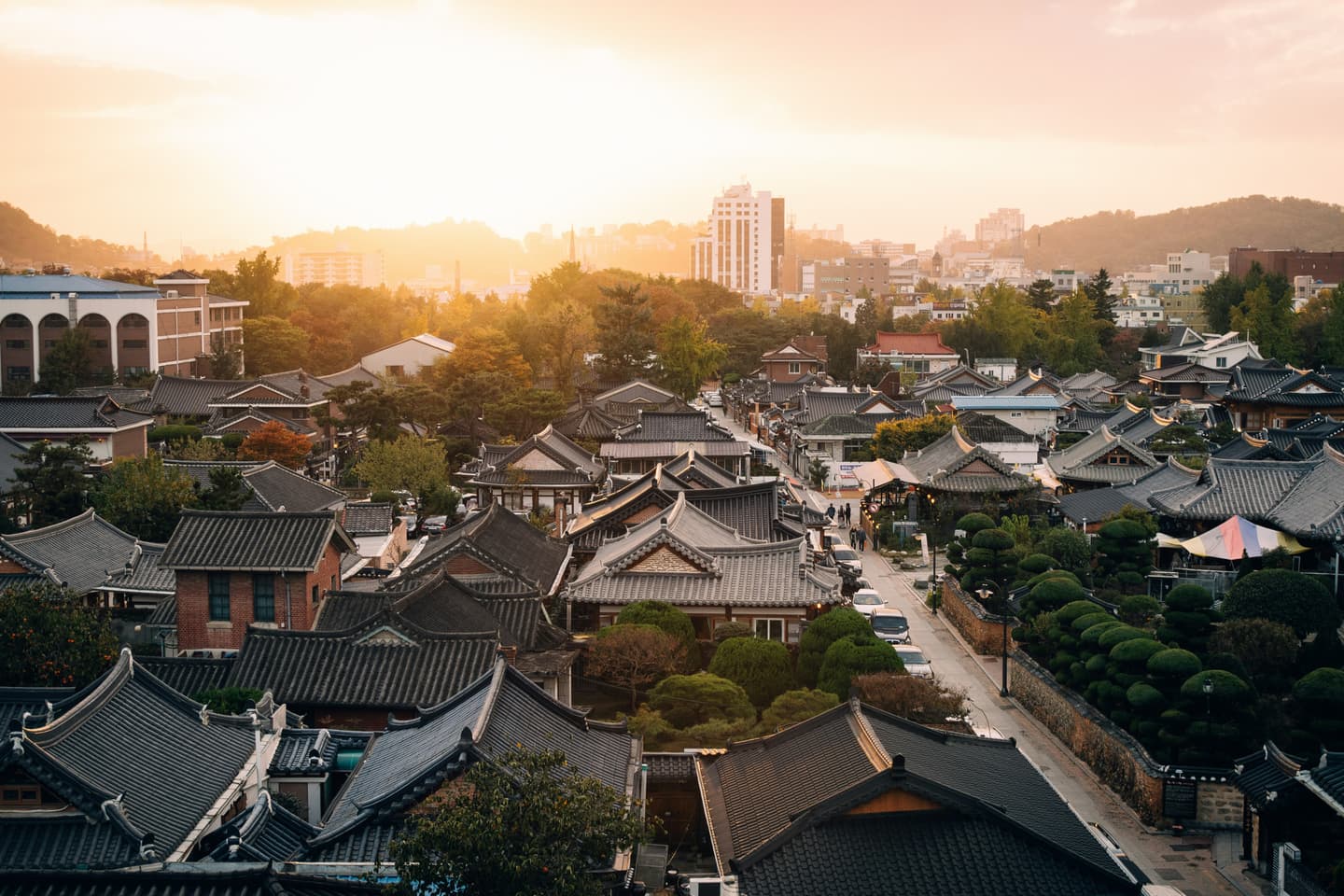
 City postcard
Seoul
Where ancient palaces meet K-pop fever and world-class street food — Seoul delivers it all, non-stop.
Loading city...
Where ancient palaces meet K-pop fever and world-class street food — Seoul delivers it all, non-stop.
 Seoul
SeoulSeoul is South Korea's pulsating capital, a city of 10 million that fuses Joseon-era palaces with futuristic skyscrapers, indie café culture, and a global pop-culture footprint. Its 25 districts each function like a city within a city, split by the Han River into the traditional north (Gangbuk) and the modern south (Gangnam). Exceptional public transit, near-universal 5G coverage, and some of the world's fastest broadband make it a dream base for remote workers and long-stay travelers alike. The city is safe, walkable, endlessly rewarding — and surprisingly affordable once you move beyond the tourist trail.
City postcardWhere ancient palaces meet K-pop fever and world-class street food — Seoul delivers it all, non-stop.
 Scenic angle
A visual anchor inside Seoul worth building into the route.
 Scenic angle
A visual anchor inside Seoul worth building into the route.
 Scenic angle
A visual anchor inside Seoul worth building into the route.
 Scenic angle
A visual anchor inside Seoul worth building into the route.
A signature stop locals and returning travelers point to in Seoul.
A signature stop locals and returning travelers point to in Seoul.
A signature stop locals and returning travelers point to in Seoul.
A signature stop locals and returning travelers point to in Seoul.
A signature stop locals and returning travelers point to in Seoul.
A signature stop locals and returning travelers point to in Seoul.
A signature stop locals and returning travelers point to in Seoul.
A signature stop locals and returning travelers point to in Seoul.
A visual anchor inside Seoul worth building into the route.
A pocket of Seoul with its own temperament — worth a deliberate detour when you're in the area.
A pocket of Seoul with its own temperament — worth a deliberate detour when you're in the area.
A pocket of Seoul with its own temperament — worth a deliberate detour when you're in the area.
A pocket of Seoul with its own temperament — worth a deliberate detour when you're in the area.
The quick answers travelers want before they commit to flights, neighborhoods, and how long to stay.
Seoul is served by Incheon International Airport (ICN), one of Asia's premier hubs, located roughly 60 km west of the city center. The fastest transfer is the AREX Express Train, which runs non-stop to Seoul Station in about 43 minutes. Airport Limousine Buses are the most convenient option if you're staying near major districts — 22 routes cover Myeongdong, Gangnam, Itaewon, City Hall, and Dongdaemun, with fares of ₩17,000–₩18,000 (approx. $12–$13 USD) per adult as of April 2025. Taxis are available 24/7 at designated stands outside Arrival Gates; ride-hailing apps Kakao T and T Map Taxi are widely used for booking. Night buses (N6001, N6002) serve the late-night gap when trains and regular buses stop around 10:30 PM–midnight. Travelers arriving from elsewhere in Korea can take the KTX high-speed rail directly into Seoul Station.
Seoul's subway is the backbone of city transport — clean, fast, bilingual (Korean and English), and one of the most extensive metro networks in the world. The T-Money card is the essential travel companion: a reloadable prepaid card accepted on subways, buses, and even in convenience stores. City buses run in color-coded route types and are budget-friendly and frequent. Taxis are plentiful and metered; Kakao T is the dominant ride-hailing app. The subway runs from approximately 5:30 AM to 12:30 AM; night buses fill the gap. Most major tourist areas are highly walkable, and pedestrian signage is clear. Coworking spaces are widely available for ₩200,000–₩400,000/month ($150–$300 USD).
Spring (April to mid-May) and autumn (late September to November) are the undisputed sweet spots for visiting Seoul. In spring, temperatures climb from a cool 10°C in March to a comfortable 23°C in May, and the city erupts in cherry blossoms — Namsan Park and Yeouido are particularly spectacular in early April. Autumn brings crisp, clear skies and vivid foliage; October is widely considered the single best month to visit. Both seasons sit in the shoulder period, meaning lower accommodation rates than peak summer and fewer crowds than July and August. Summer (June–August) coincides with Korea's monsoon season (jangma), bringing oppressive heat, humidity, and the highest tourist volumes — book well ahead if you must travel then. Winter (December–February) is cold and occasionally snowy, but it's the cheapest time to visit, with fewer crowds at major sights and attractive airfare deals.
Real coworking spaces, top-rated cafés, and libraries pulled from Google Maps near the center of the city — sorted by rating so you start with the strongest desks.
No coworking-ready spots surfaced for this city yet.
Pick a different category or check back once we’ve indexed more desks for this city.
Ask for cafés, quiet neighborhoods, date-night spots, or a first 48-hour plan.
Mention calls, Wi-Fi needs, or how much of the day has to stay laptop-friendly.
Get faster answers on where to stay, when to move neighborhoods, and what to skip.
There aren’t any, yet!
Block off the weeks you're free. Wanderlust turns this dossier — flights, lodging, neighborhoods, timing — into a single draft itinerary in about ninety seconds.